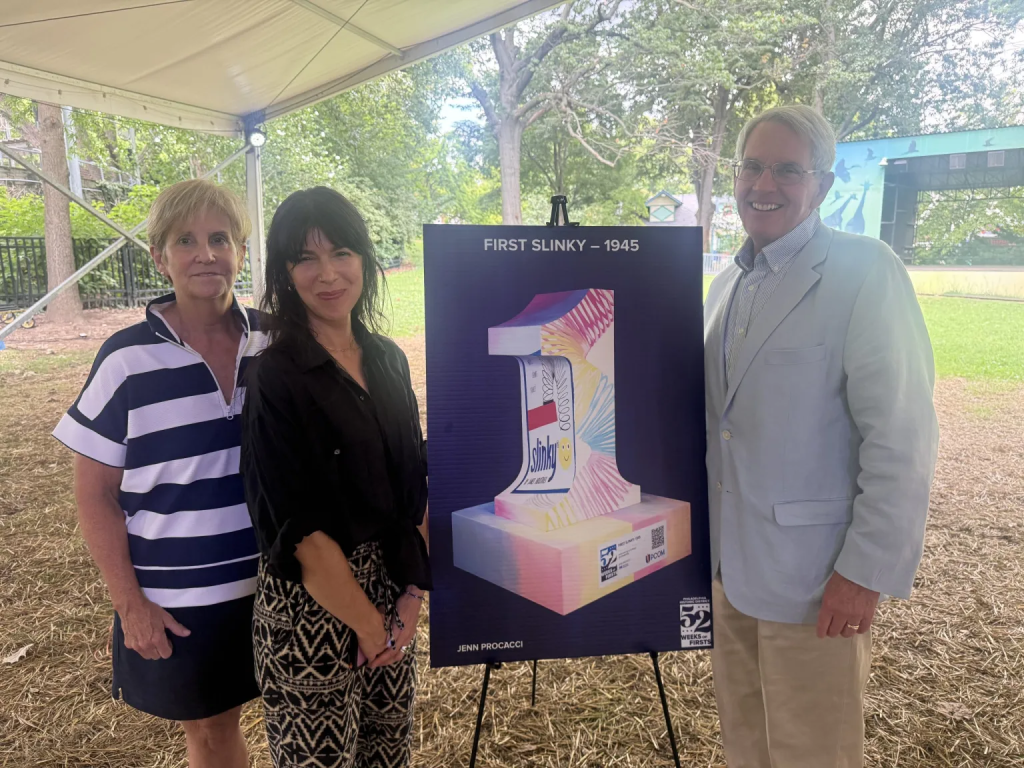
Rebekah James Morris (far left) and Christopher James (right) are the children of “Slinky” toy creators Richard and Betty James. Jen Procacci (second from left) created this week’s Firstival design (Violet Comber-Wilen/Billy Penn)
The first Slinky was made in Philly, and its legacy lives on through the inventor’s children
Richard James didn’t set out to create the first Slinky in the United States – the idea sprang to him.
The Philadelphia-based mechanical engineer worked around springs that would keep fragile equipment steady on ships, and after knocking one of the springs from a shelf, an idea for a new toy leapt into his mind.
Its initial success began in 1945, when James debuted the toy at a Gimbels department store in Philly and impressed many paying customers.
But Richard James was not the only one involved with this invention — according to two of James’ children, Christopher James and Rebekah James Morris, their mother, Betty, came up with the word “Slinky” and did more to increase its popularity.
The company that created the toy was bankrupt by the 1950s, and Richard left his family in the 1960s to join a religious sect.
It was up to Betty to revive the company – and the Slinky in the process.
“Mom was the one who sort of had everything going,” Rebekah said. “After he left, he left it in bankruptcy with the company in 1960. So she really got the jingle going, and she put it on TV.”
“Our mom raised all six of us by herself with the company,” she said. “So really, she was pretty busy, and we had to sort of make do around the house. We lived a little bit outside of Hollidaysburg, so we had a lot of place to play. It was normal for us, but unique.”
Betty brought the Slinky to a New York toy show in 1963, created a catchy jingle, and eventually even inspired a Toy Story character that’s now the basis for a major roller coaster at Walt Disney World..
“In 1995, Disney called her and said, ‘Do you want to be in Toy Story?’” Rebekah said. “And she was like, ‘Yeah, you don’t turn down Disney.’ So she was very excited.”
Modern-day nostalgia
Growing up, Christopher and Rebekah say they still had a normal life as their mother worked to produce the toy.
“I don’t think it really hit us until the Slinky and my mother sort of matured into it, and Hollywood became its final home,” Christopher said.
By the end of the 1990s, the History and Discovery channels named Slinky one of the 20th century’s top 10 toys.
Additionally, it was a National Toy Hall of Fame Inductee in 2000.
Betty eventually sold the Slinky brand to Michigan-based toy company Poof Products, and she passed away in 2008. The brand is now owned by a company called Just Play.
Jenn Procacci created the firstival statue honoring Slinky as part of the city’s 52 Weeks of First series. She said she hopes to capture the nostalgic essence of the toy while giving homage to its creators.
“I went with really bright colors for this one because we all know Slinky is the essence of nostalgia,” she said. “I wanted the viewers to get a little bit of history with the blueprint and the logo, but also to really just feel the joy when they saw what we all felt as kids playing with this iconic toy.”
Billy Penn Newsletter
Violet Comber-Wilen
August 27, 2026


 OLIVER EVANS CHAPTER
You must be logged in to post a comment.